
I have written several posts about early reading and some of the resources we have used in the past before, and delved into the philosophy, why's and hows. While I wouldn't mind revisiting these topics, that is not the purpose of this post. I just want to have a place to share some of the Doman-style reading resources I have made for my youngest two especially. This will be a living page- I will be adding more files as I create them, and I have lots of ideas!
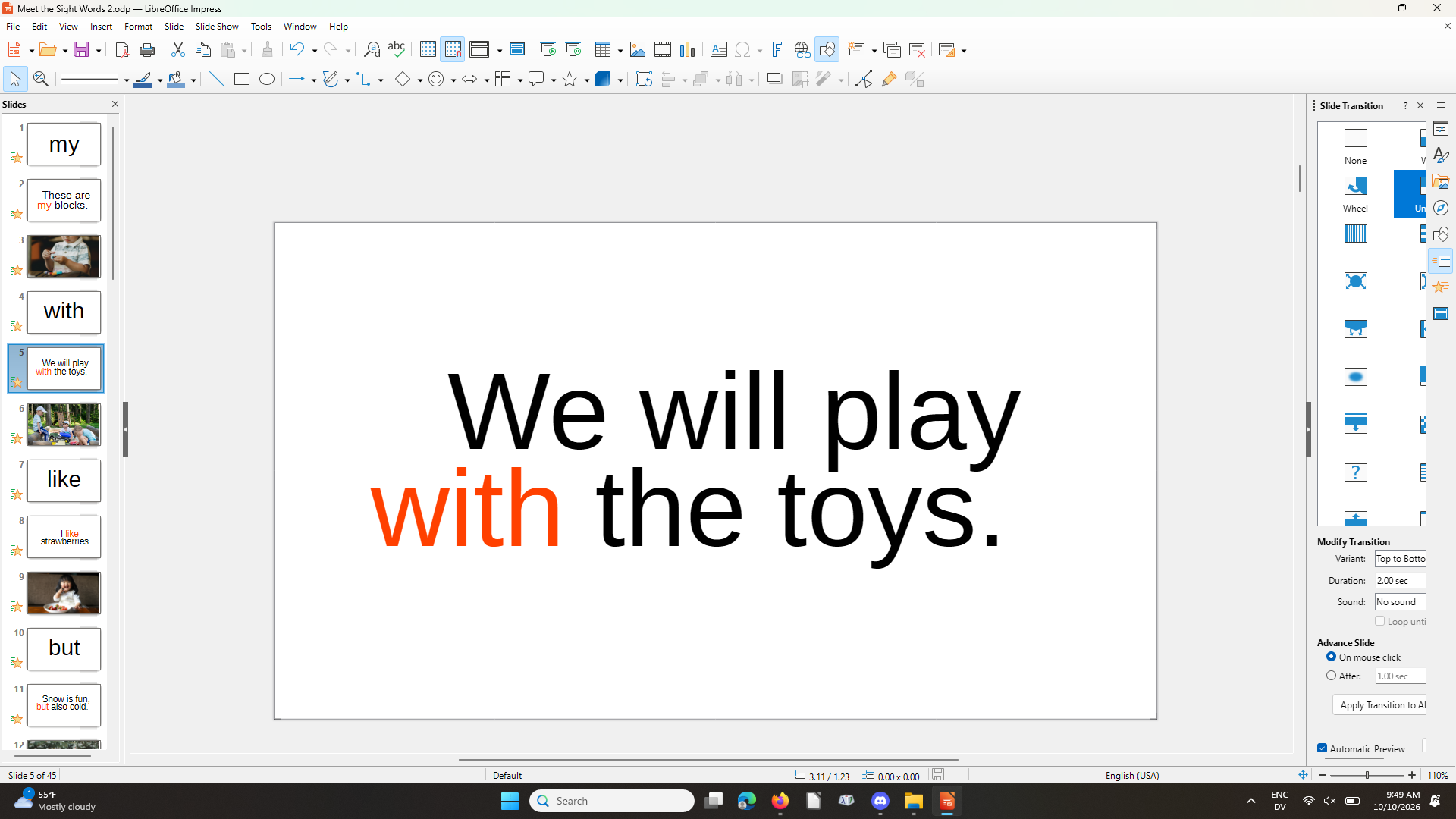
Libre Office is a free, open source office suite comparable to Adobe. I used to use Power Point, Word, and Photo Shop almost exclusively, but in recent years I have been disenchanted because it has become more expensive, and it is a subscription based platform. Even old files I've made in the past are difficult to access without paying a premium. So moving forward I am choosing Libre Office. I love open source. Muse Score is another open source program I use a lot for creating and editing music files. LibreOffice Impress is the slide presentation program I used to create these slides, and you will need it to get the most out these files.
Meet The Sight Words
My kids have all loved Preschool Prep's Meet the Sight Words. This post is not sponsored or endorsed by them in any way- this is fan-made supplemental material. We have them on DVD but have more recently enjoyed the convenience of watching them on YouTube. Once kids know their sight words, they have word friends that show up everywhere! It becomes a game to look for them.
These slide presentations feature the same sight words Preschool Prep uses. Each word has 3 slides. One with only the word, one with a short sentence with the word highlighted in red, and finally a picture illustrating the sentence. I sourced these pictures off of unsplash.com.
On a personal note- these are not the exact files I use with my little boys. They are more generic. For my boys, I have pictures of our family, of our house, and even some of their favorite toys. Children love seeing themselves on the big screen! And because these slide shows are editable, you can tweak them for your family too if you wish. But if you don't feel ambitious, these files will work spendidly as is too.
McGuffy's Eclectic Primer
McGuffy's Eclectic Primer is a reading program that has definitely withstood the test of time! With the caveat that it is hardly universally used anymore. There are pros and cons to this program. For me, I think the pictures and stories are charming, the pacing is robust but not too challenging for most kids willing to practice the lessons, and there is a nice blend of sight words and phonetic introductions. I think it is a great place to explore after learning sight words.
Cons to the McGuffy series- some people think it is too robust. It moves much faster than some other curriculums. Remember that back when these were popular, books were very precious and one wouldn't have as many books as a book loving family will amass today. Imagine picking only a few books worthy of space in a covered wagon as you move west with your family. Books like the McGuffy series and Ray's Arithmetic made the cut because education was important, but there wouldn't have been 50 board books. The authors were very aware of what needed to be taught and they condensed the material in as small a space as possible. As such, I recommend these older books for homeschooling families with children who are bored with their material- let them breeze through the lessons until you find a place where the material becomes challenging, then you know about what "grade level" your child is at. Then you can either stick with these older programs, or get something a bit more flashy and colorful if that's what you want for your kids.
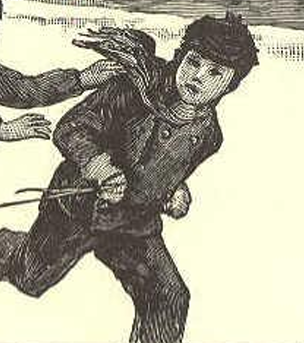
But there is one other critisism that I have that I simply cannot ignore. What's up with all the fat characters? Like this boy, Tom. In lesson 19, we learn that he is too fat to run fast, and Nat can catch him. Just look at how fat he is! Ugh. Does't look so fat to me. I get that "fat" is a phonetic word convenient to use, and maybe kids thought it was funny back in the day, but this particular part of the curriculum hasn't aged well. We meet all kinds of fat creatures. A fat dog, a fat nag (horse), a fat chicken... Okay, fine, maybe the chicken really was fat. But still.
I haven't edited the fatness out of these lessons, so just be advised that they exist. I use them anyway, but joke about how silly the book is because this boy isn't fat. Even if he was fat, is it nice to say so? No. That might hurt his feelings. And then we talk about it.
My process began with the Public Domain book I downloaded from Project Gutenburg. I took the original text and images, and "Doman"-ized them by making the sentences very large, followed by rewarding the reader with pictures. I didn't have a lot to work with as far as pictures go, so I cut and pasted different parts of the picture. Every 5th lesson is a review lesson, where I had even less to work with, but I included what I could. Obviously I could have found pictures for these sentences, but I wanted to preserve the integrity of the simple McGuffy lessons without too many bells and whistles.
Short Books
These books were created in Canva, and are PDFs instead of LibreOffice Impress slide shows. They are definitely more of a Doman approach, with more of a focus on making the text as interesting as possible than on phonemic progress. I didn't really use phonics to teach my kids to read, though I don't mind using such resources when they are convenient. My kids picked up phonics on their own- again a topic for other posts.
"Let's Go to the Farm" is inspired by BrillKid's first Little Reader book "Let's Go to the Zoo". Dang, I miss Little Reader so much! This book has a lot of repetition, and introduces a lot of farm animals!
I wrote "My First Train Book" because my little one is obsessed with trains. So I created a book to match his passion, and included as many interesting things about them as I could. It was initially longer than his attention span, so I divided it in two, but now he loves to read the entire thing with me.